
Ranking the Greatest Receiver Corps in Packers History
The Packers have had some outstanding wide receivers in their history, but which group was the best receiving corps overall? We look back at and analyze the greatest groups of receivers in Packers history.

By GilMartin
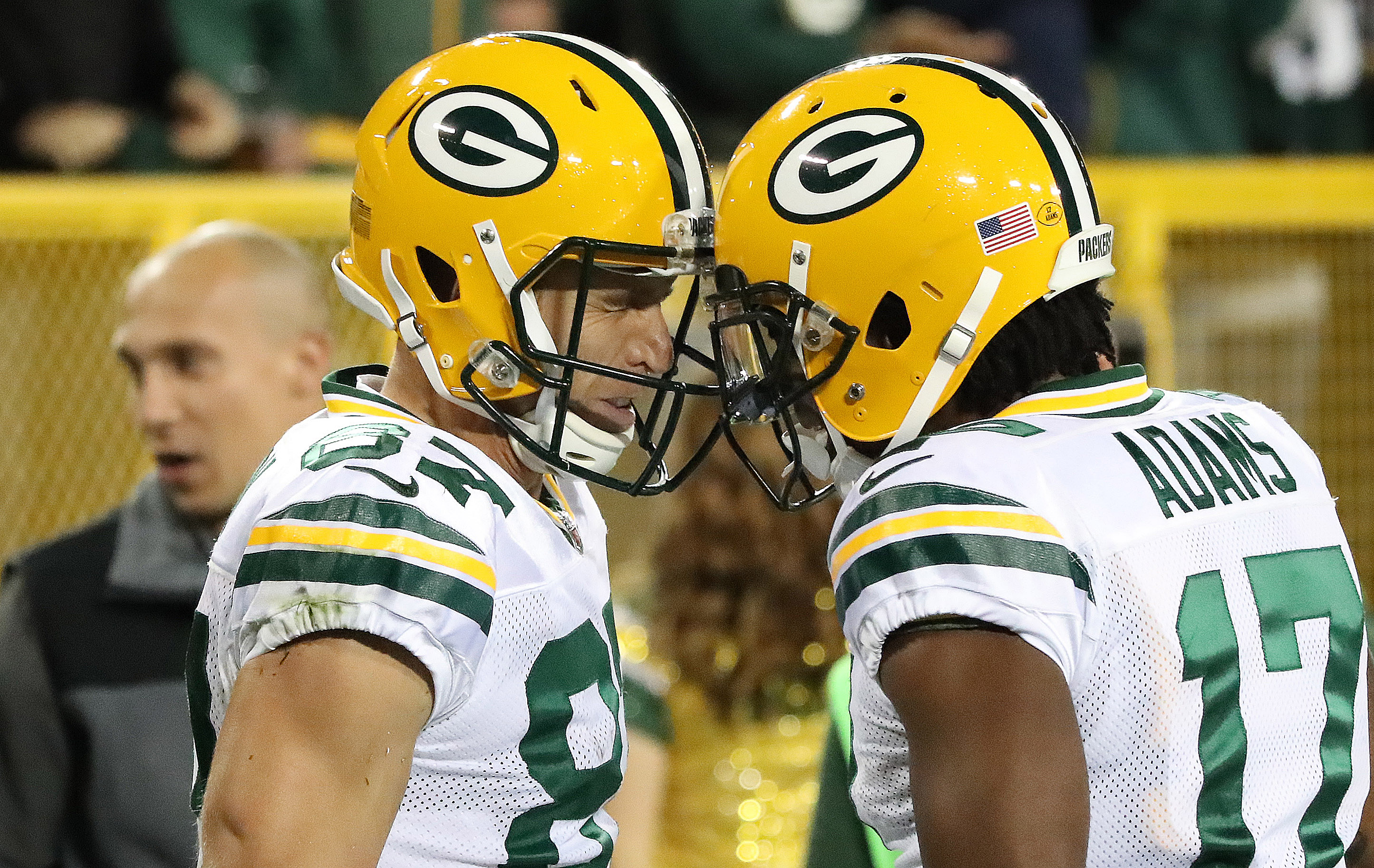
The Green Bay Packers have had more outstanding players at receiver throughout their history than arguably any other position. Some of these all-time greats include Don Hutson, Boyd Dowler, James Lofton, Sterling Sharpe, Antonio Freeman, Greg Jennings, Donald Driver and Jordy Nelson.
But what about receiving corps? Not just one outstanding receiver but a unit of pass catchers that was particularly effective as a unit. This includes the receivers, tight ends and running backs who were active in the passing game.
An outstanding season by one receiver with no significant contributions from his supporting cast will not get a unit on this list. That’s why Don Hutson isn’t listed here, he never had any other receivers who were productive alongside him.
Statistics are also adjusted for eras so a 45-catch season in the early 1960s may be just as valuable as a 75-catch season 30 years later because teams in the NFL passed so much less frequently before 1978 when the rules changed to open up the passing game.
Here are the six best Packers receiving corps in Packers history listed in chronological order. Feel free to mention which you think is best or to discuss a group you feel belongs on this list but was omitted.
1962 WR Max McGee, WR Boyd Dowler, TE Ron Kramer, RB Jim Taylor
The 1962 Packers were a run-first team, but they also had a talented receiving corps on a team that went 13-1 and won Vince Lombardi’s second straight NFL championship. They also led the NFL in points scored.
Max McGee and Boyd Dowler tied for the team lead with 49 catches each. McGee averaged 16.7 yards per catch while Dowler averaged 14.8. Quarterback Bart Starr also had an All Pro tight end to throw to in Ron Kramer who added 37 catches for 555 yards and a team-high seven touchdown catches. Fullback Jim Taylor added 22 catches.
All three of the top receivers have been inducted into the Packers Hall of Fame while Taylor is also in the Pro Football Hall of Fame.
These players gave Starr plenty of great options when looking for a receiver on pass plays.
1983 WR James Lofton, WR John Jefferson, TE Paul Coffman, RB Gerry Ellis, WR Phil Epps
The Packers had an exceptionally dynamic group of pass catchers in the early 1980s and their offense was among the most dangerous in the NFL.
Quarterback Lynn Dickey became the first Packers quarterback to pass for 4,000 yards in a season when he threw for 4,458 yards and 32 touchdowns in 1983. Unfortunately, the team’s defense was as porous as the offense was dangerous and the Pack finished 8-8.
Hall of Famer James Lofton was the most dangerous deep threat in the game, catching 58 passes for exactly 1,300 yards and eight touchdowns. He averaged an impressive 22.4 yards per catch and was voted to the Pro Bowl.
Starting opposite Lofton was John Jefferson who the Packers had acquired two years earlier from the San Diego Chargers. Jefferson ran more intermediate routes over the middle and was also among the top receivers in the game at that time. He caught 57 passes for 830 yards and seven touchdowns.
Tight end Paul Coffman also made the Pro Bowl after catching 54 passes for 814 yards and 11 touchdowns. Coffman was tough, rugged and rarely dropped a pass he got his hands on.
In addition, running back Gerry Ellis caught 52 passes for 603 yards. Ellis was an elusive receiver who was always a threat to turn a short pass into a bigger play. The Packers also had outstanding speed at the third receiver position with ex-track star Phil Epps filling that position.
The Packers offense finished second in the NFL in passing yards and first in touchdown passes that year.
1994 WR Sterling Sharpe, WR Robert Brooks, TE Ed West, TE Mark Chmura, RB Edgar Bennett, RB Reggie Cobb
Sterling Sharpe made the Pro Bowl again in 1994 but it ended up being his final campaign before a neck injury forced him to retire. Sharpe had “only” 94 catches that season after topping 100 the previous two seasons. He also caught a league best and career high 18 touchdown passes. The other starting receiver was Robert Brooks who added 58 catches and four scores that season as the second option. Brooks would go on to gain more than 1,000 yards just a year later.
Both starting RBs were also excellent receiving options. Edgar Bennett caught 78 passes for 546 yards and four scores while Reggie Cobb caught 35 more passes out of the backfield.
The starting tight end was Ed West, a reliable receiver who added 31 grabs for 377 yards and two scores.
This group had diverse skill sets with Brooks being more of a deep threat and Sharpe being the stronger, intermediate target. They gave Brett Favre plenty of options on a team that reached the playoffs for the second consecutive season.
1996 WR Antonio Freeman, TE Keith Jackson, TE Mark Chmura, WR Don Beebe, WR Robert Brooks, WR Andre Rison, RB Edgar Bennett
This group was talented and deep but had trouble staying healthy. Freeman suffered a broken arm in midseason and missed four full games while Brooks was lost for the season before the campaign was even half over.
The Packers had depth and they were able to utilize it successfully. Don Beebe averaged 17.9-yards per catch as the third receiver. Terry Mickens, Derrick Mayes and Desmond Howard also contributed. When injuries struck, the Packers added former Pro Bowler Andre Rison who was came up with a memorable touchdown in the Packers victory over the Patriots in Super Bowl XXXI.
The Packers also had what was arguably the best tight end duo in the league with Pro Bowler Keith Jackson and the tough and reliable Mark Chmura. Jackson led the team with 10 touchdown catches including four in the season opening win in Tampa Bay.
All three of Green Bay’s primary running backs were also very capable receivers. Edgar Bennett, Dorsey Levens and William Henderson were all able to catch passes from Favre to help keep drives alive by gaining yardage after the catch.
The Packers had an exceptionally deep and talented group of receivers this season even though no player topped 1,000 yards, the 1996 crew certainly got the job done.
2011: WR Greg Jennings, WR Donald Driver, WR James Jones, WR Jordy Nelson, TE Jermichael Finley, WR Donald Driver
The 2011 Packers offense was exceptionally dangerous, and the deep receiving corps was a big reason. Aaron Rodgers led the Packers to a 15-1-0 record, and they finished first in the league in points scored, third in passing yards and first in touchdown passes.
Jordy Nelson led the team with 68 catches and 1,263 yards and 15 touchdowns. Greg Jennings made the Pro Bowl despite playing just 13 games but still had 67 catches, 949 yards and nine scores.
The backup receivers included all-time franchise reception leader Donald Driver, the reliable James Jones and rookie Randall Cobb who finished seventh on the team with 25 catches.
Jermichael Finley was still healthy and made 55 catches including eight scores. The Packers have yet to add a tight end who can stretch the field as well as Finley did since was forced to retire.
The depth and talent of this group was outstanding.
2016: WR Jordy Nelson, WR Davante Adams, WR Randall Cobb, RB Ty Montgomery, TE Jared Cook, TE Richard Rodgers
The 2016 Packers reached the NFC Championship Game largely on the strength of the team’s passing game which featured Rodgers throwing to a talented and deep receiving corps.
Jordy Nelson led the way with 97 catches for 1,257 yards and 14 scores. Davante Adams added 75 receptions for 997 yards and 12 touchdowns. Randall Cobb was the third receiving option and he added 60 catches predominantly from the slot.
Jared Cook was the starting tight end. He missed six games due to injury but came up big in the playoffs against Dallas. Cook was the Packers best tight end since Finley’s retirement. Richard Rodgers was more of a possession receiver, but he added 30 catches and two more scores.
Even the Packers top running back, Ty Montgomery, was an excellent target. The former Stanford star was a converted wide receiver with sure hands. He led the team in rushing while adding 44 catches as an outlet receiver for Rodgers.
PLEASE SUBSCRIBE TO OUR CHEESEHEAD NATION WEEKLY NEWSLETTER HERE.
__________________________
You can follow Gil Martin on Twitter @GilPackers
__________________________








Comments (16)
gkarl
May 07, 2020 at 12:11 pm
Hard to choose, especially across different eras and how the game has evolved over time. Seems like there all the best because they're all Packers.
GilMartin
May 07, 2020 at 12:44 pm
So many great groups of receivers throughout the franchise's history. Yes it is tough to choose. Thanks for commenting gkarl.
crayzpackfan
May 07, 2020 at 01:01 pm
The old guy nostalgia in me would say Lofton and Jefferson. Wish I could take duo WR’s with duo TE’s at the same time. Brooks, Freeman, Chmura, and Jackson. But hey, I’ll follow the directions. Tough question.
GilMartin
May 07, 2020 at 01:03 pm
It is a tough question. Loved Lofton and Jefferson and remember them teaming with Coffman so well. Lynn Dickey had so many great weapons to utilize. If the defense had just been average, the 83 team could have won 10 games easily.
Thanks for the comment.
marpag1
May 08, 2020 at 07:56 am
It's not "old guy nostalgia" at all. Since 1960, not one Packer team has lead the league in receiving. Only three teams were second in receiving... and one of them was 1983. I'll write more in a separate post below.
WMA
May 07, 2020 at 04:30 pm
1962 receivers best group overall. The 83 group was fun to watch - Lofton made everything look effortless.
GilMartin
May 07, 2020 at 05:26 pm
Glad to hear some love for the 62 group. The Packers were a run-oriented offense then but the receiving corps was very strong. As for Lofton and the 83 unit, man they were so dangerous. Thanks so much for commenting.
JonathanSpader
May 07, 2020 at 05:28 pm
Don Hutson is one of the greatest WRs of all time.
The 2014 combination of Nelson, Cobb, and Adams was one of the most explosive offenses the NFL has seen. That was year Lacy showed he could catch as well as run and his last good year in the NFL. Quarless was forgettable at TE.
GilMartin
May 07, 2020 at 05:31 pm
Hutson was in my mind the most dominant receiver ever in NFL history and one of the best, but he never had anybody else teamed with him to make a great unit. 2014 was strong, no doubt although as you mentioned, the TE play was pedestrian. Lots of good units to choose from. Thanks for commenting, JonathanSpader.
flackcatcher
May 07, 2020 at 06:24 pm
Quarless was good as a rookie thrown in when Finlay went down. Part of that 2011 group with Finlay, was just coming into his own when his knee just blew up on Giants turf. Real talent. Never the same again.
GilMartin
May 08, 2020 at 12:20 pm
Unfortunately, he was not as good after that, you're right. Plenty of potential had he stayed healthy. Thanks for commenting.
splitpea1
May 07, 2020 at 05:42 pm
I hope nobody forgot the touchdown Don Beebe "stole" in a regular season game vs. San Francisco in 1996. He appeared to be down by contact, but the refs didn't call it and he scampered a long way downfield for a touchdown. We ended up winning that game in overtime, and without that win, we wouldn't have secured home field throughout the playoffs.
GilMartin
May 07, 2020 at 05:45 pm
I remember that game well. Beebe had a monster game overall. He had 11 catches for 220 yards and the touchdown. He remembered that game fondly when I interviewed him and it was a huge win for the Packers that as you mentioned, helped clinch home field that season. Thanks for the comment, splitpea1.
wildbill
May 07, 2020 at 10:20 pm
Loved the 62 group as I got to watch them but the quality and depth of the 2011 team is hard to beat
murf7777
May 08, 2020 at 07:22 am
What?! no Adams and everyone else~~
marpag1
May 08, 2020 at 09:41 am
We all agree that the game has changed over the years from a predominantly running league to a passing league. So you can't compare GB from 1962 with GB from 2011. A MUCH better stat is to see how GB receiver groups compared to the groups from other teams in the same season. In other words, how did GB rank in receiving relative to the rest of the league?
The author says that he adjusted stats for the era.... I don't get that at all. FIrst, it's a make believe non-stat, and second it doesn't show how good these guys were relative to their peers in the league. NFL ranking in receiving yards is a much better way to look at it IMO. People can debate that if they want. I suppose the question is going to be how much do we judge based on our perception of the players' skill, and how much do we judge based upon actual, real production?
If we measure greatness by NFL ranking, then the 1962 Packers do not even deserve to be considered. They ranked 18th out of 22 teams in receiving yards. Are they one of Green Bay's best ever?? Nope. Here's how the author's choices line up by NFL ranking in receiving yards (year - ranking).
1983 - 2 of 28
2011 - 3 of 32
1996 - 5 of 30
2016 - 6 of 32
1994 - 9 of 28
1962 - 18 of 22
These are the only top 5 offenses in terms of receiving yards since 1960.
2nd - 1983, 1995, 2007
3rd - 1998, 2011
4th - 1989, 2001
5th - 1990, 1996, 2004, 2010, 2013, 2014